Tesla's Semi Gets A Face-Lift Eight Years After Its Debut, With Volume Production Still On The Horizon
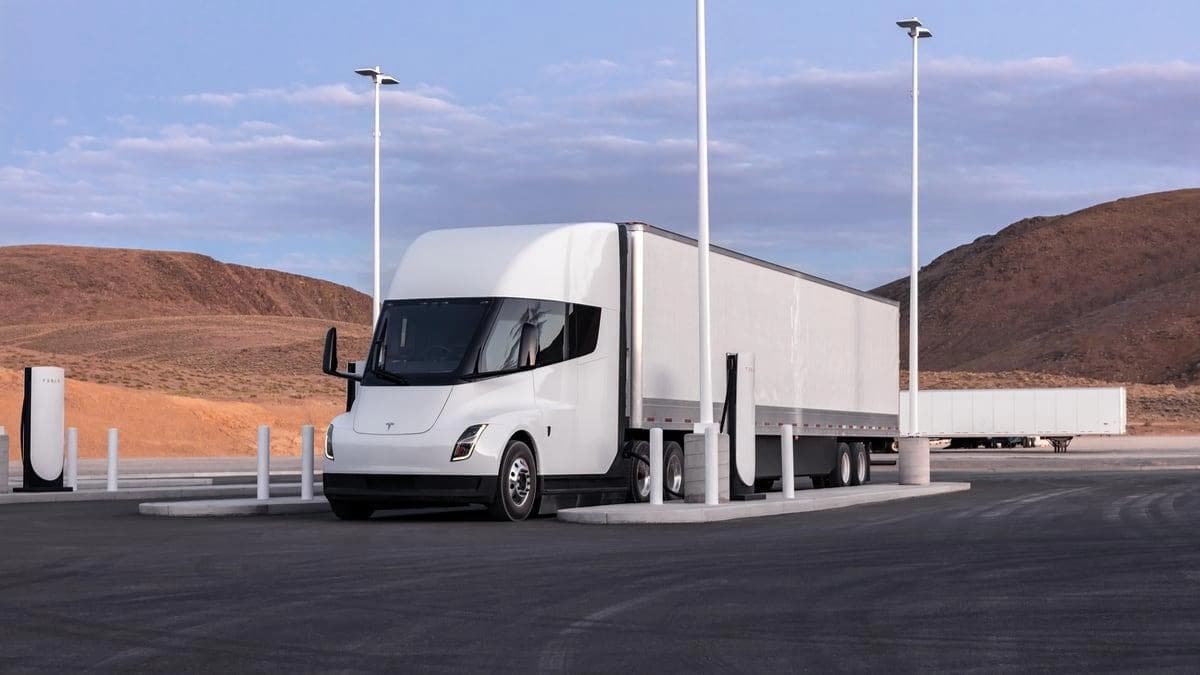
Image courtesy of Tesla
Let me paint you a picture: It's 2017. The world is simpler. You're probably still using an iPhone with a headphone jack. Game of Thrones hasn't disappointed anyone yet. And Elon Musk unveils the Tesla Semi, promising deliveries would start in 2019. Two years, he said. An ambitious target for an ambitious truck.
Fast forward to 2025—eight years later—and Tesla just unveiled a facelifted version of a truck that's seen limited production. Only about 150 units have been built since the first delivery in December 2022. It's a modest number that underscores just how challenging bringing an electric Class 8 truck to market has proven to be—not just for Tesla, but for the entire industry navigating new technology at scale.
But hey, the redesigned version looks notably different! It now sports the same blade-like light bar treatment that's on the new Model Y and Cybertruck, reinforcing Tesla's evolving design language. More importantly, Tesla claims it's achieved a 15% efficiency improvement, dropping energy consumption to 1.7 kWh per mile. Combined with the 500-mile range target, that's actually legitimately impressive for a Class 8 truck hauling serious weight.
The charging infrastructure is where things get interesting. The updated Semi supports 1.2 MW charging—that's 1,200 kilowatts for those keeping score at home. Tesla claims this'll enable significantly shorter charging stops when paired with compatible infrastructure. The challenge? That compatible infrastructure doesn't exist yet in meaningful numbers, though Tesla's building out 46 public MCS stations along major freight corridors by 2027. Infrastructure development remains one of the biggest hurdles for the entire electric trucking sector.
Payload capacity is also increasing, though Tesla hasn't specified by how much. The drive power remains at 800 kW, but internal improvements in cooling, software, and thermal management supposedly provide more consistent performance under load. It's all very impressive on paper—and the real-world validation will come as production scales.
Here's an interesting footnote: at the same shareholder meeting where he unveiled the Semi updates, Musk also promised the long-awaited Tesla Roadster would finally be revealed on April 1, 2026. April Fool's Day. He even joked that the date "affords some deniability" if it slips. Say what you will about Musk's timelines, but his self-awareness about them has become part of the brand.
The Nevada Gigafactory dedicated to Semi production is allegedly nearing completion, with Tesla claiming it'll be ready for up to 50,000 units annually once fully ramped. When might that happen? Tesla says volume production starts in 2026, though the company has adjusted that target several times over the years. Managing expectations while scaling revolutionary technology is a balancing act every EV manufacturer knows well.
To be fair, what Tesla has accomplished with the Semi prototype fleet is genuinely noteworthy. PepsiCo has been running several units, and by all accounts, they perform well in real-world conditions. The efficiency gains are real, the instant torque is useful for heavy hauling, and the lower operating costs compared to diesel are compelling. The challenge isn't that the Semi underperforms—it's bringing it to scale.
Meanwhile, competition is intensifying. Daimler and Volvo are ramping up their electric Class 8 offerings, and the race to electrify freight is heating up across the board. Tesla's early-mover positioning faces increasing pressure as rivals accelerate their own programs.
Look, the updated Semi is legitimately cool. The specs are impressive, and when Tesla achieves mass production, it could genuinely disrupt the trucking industry. After eight years of development, prototypes, and production challenges, healthy skepticism about the 2026 timeline is understandable. But the potential remains enormous—and we'll be watching closely as those fleets hopefully start rolling down I-80.