Slate's Great Plastic Gamble Is Officially On for $24,950
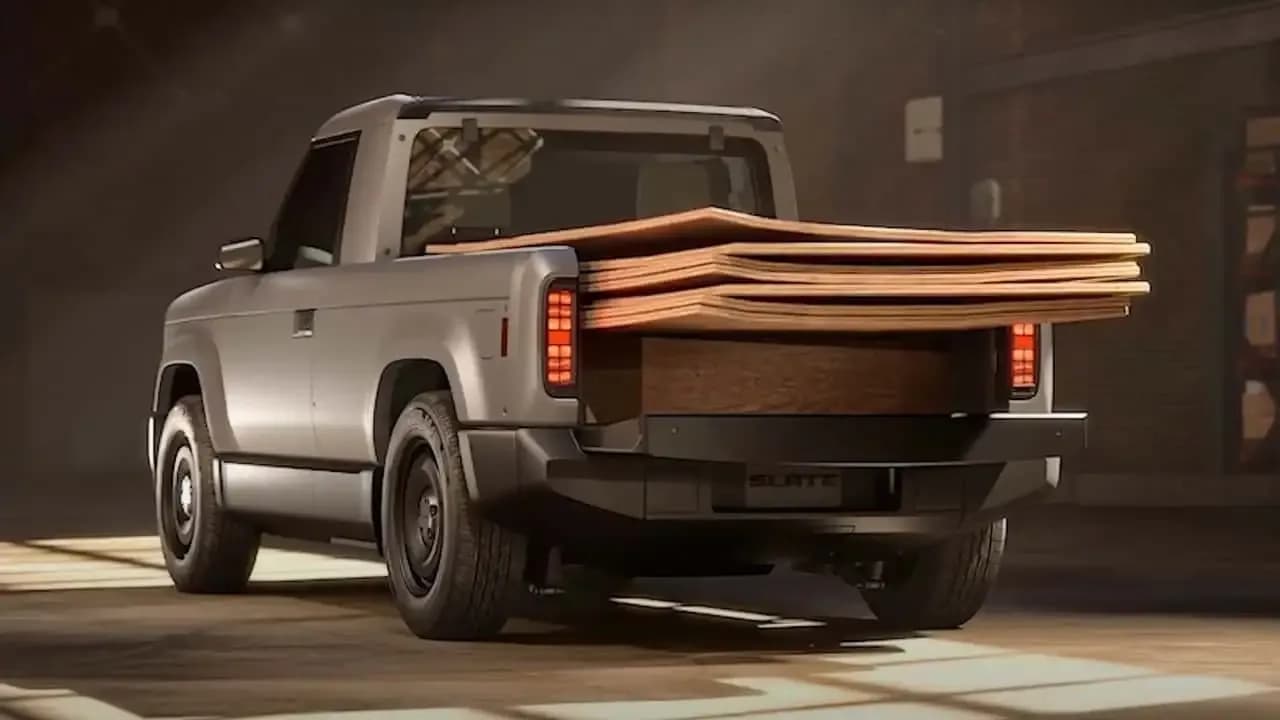
Image courtesy of Slate
The official reveal just happened at Slate's new design headquarters in Gardena, California, a sprawling industrial space that used to be a home furniture salvage center. The leaked price of $24,950 is officially set in stone. Now that the corporate curtain has pulled back, we finally know the full engineering and financial reality of America's cheapest electric vehicle, which looks less like a pickup and more like a Rubbermaid store container rolling on a set of wheels.
The biggest technical surprise of the launch event centered around the battery architecture. Instead of forcing buyers to navigate a complicated choice between a meager 150-mile base battery and an expensive extended-range version, Slate completely changed its strategy. They pivoted to a single 65 kilowatt-hour lithium-iron-phosphate battery pack supplied by Gotion, which delivers 63 kilowatt-hours of usable energy. This chemistry adjustment bumped the base driving range up to an impressive 205 miles per charge. While this means high-end buyers lose out on the previously rumored 240- mile premium option, it represents a massive victory for budget-focused commuters who now get significantly more distance without paying a premium.
To maintain that incredibly low baseline price, the engineering team made several mechanical compromises underneath the gray plastic skin. The single rear-mounted electric motor suffered a slight power drop compared to early development prototypes, settling at a modest 181 horsepower and 195 pound-feet of torque. The suspension layout is equally pragmatic, utilizing a basic MacPherson strut setup up front and a rigid, non-independent de Dion rear axle with coil springs to maximize payload capacity at 1,550 pounds. Despite these bare-bones components, the first journalists to get behind the wheel during the media launch reported that the vehicle is shockingly entertaining to pilot, offering a nimble, car-like driving experience that makes you completely forget you are driving a utility vehicle until you glance back at the five-foot cargo bed.
Modularity is where the Slate project shifts from a simple budget vehicle into an automotive equivalent of Swedish flat-pack furniture. In its standard form, the truck is strictly a two-passenger pickup with a modest front trunk. However, the company simultaneously opened an online accessory catalog featuring more than one hundred items that owners can install themselves in their own driveways. Alongside forty different vinyl color wraps priced at an affordable $499 to mask the factory gray polypropylene, Slate revealed official pricing for its structural body kits. For a $5,000 premium, you can purchase the Squareback SUV kit, which appends an enclosed rear canopy and a functional back seat to accommodate five passengers. If you prefer a sleeker look, the Fastback SUV kit commands a $7000 premium.
To prove that everyday owners can actually handle these radical body modifications without ruining their vehicles, Slate dropped its first series of instructional videos called Slate University. These digital tutorials walk buyers through everything from bolting on the SUV body kits to clipping on personalized headlight covers. The company is leaning heavily into an open-source philosophy, actively encouraging buyers to tackle their own maintenance or visit independent repair shops rather than relying on an expensive, traditional network of corporate franchise dealerships.
Preorders are officially open on the company website right now for a nonrefundable $300 fee, and the company is allowing its massive backlog of 180,000 early reservation holders to transition into the production queue immediately. Slate expects the very first customer deliveries to begin before the end of the fourth quarter of this year, though full assembly line scaling at the Warsaw, Indiana factory will take most of next year to reach maximum capacity. Armed with over one billion dollars in funding and backed by prominent investors like Jeff Bezos, the startup is launching a massive experiment in consumer psychology. If American buyers are truly willing to trade away luxury features for an affordable, twenty-five-grand plastic workhorse that they can rebuild themselves, the entire industry is about to look very different.