Honda’s New Trailer Is the Space Pod We Didn’t Know We Needed
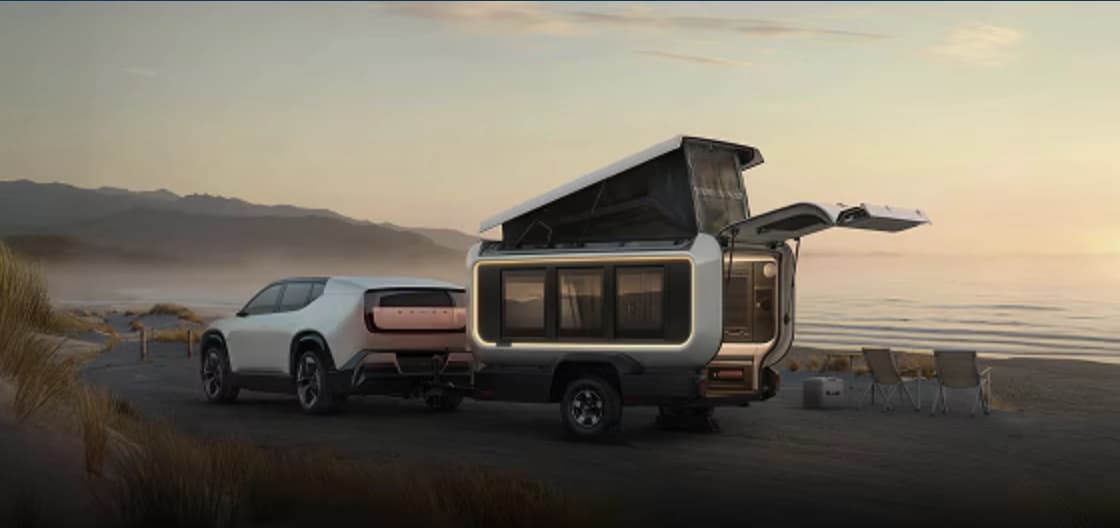
Image courtesy of Honda
Honda has a history of doing weird, delightful, and completely unexpected things when nobody is looking. This is the company that gave us the Motocompo (a scooter that folds into a briefcase), the Element (a toaster on wheels that you could hose out), and Asimo (the robot that could run, albeit creepily). But lately, they have been very… sensible. Competent? Absolutely. Exciting? Rare. That changed this morning with the unveil of the "Base Station," a camping trailer concept that looks like it rolled off the set of The Martian and is designed specifically to solve the headaches of towing with an electric vehicle.
The Base Station isn’t just a fiberglass box on wheels. It is a masterclass in aerodynamics and weight reduction. If you have ever tried towing with an EV, you know the pain. Most travel trailers are essentially bricks; they have the aerodynamic properties of a school building. When you hook a brick to an EV, your range doesn't just drop—it plummets. You go from 300 miles of range to 120 miles, turning a road trip into a charging station hopping nightmare. Honda’s R&D team approached this problem with the same obsession they apply to Formula 1 engines.
The trailer is teardrop-shaped but features active aero elements—flaps and ducts that smooth the airflow coming off the tow vehicle to reduce drag turbulence. It sits low to the ground on the highway to slice through the air, but features an adjustable air suspension to lift it up when you hit the trail. It is sleek, futuristic, and looks like it belongs behind a Lucid Gravity or a Rivian R2, not a beat-up F-250.
But the real magic is inside. It is modular, borrowing heavily from the clever packaging of the Honda Fit (RIP). The interior is a grid system. You want a kitchen? Snap in the kitchen module. You want bunk beds for the kids? Snap them in. You want an empty cargo bay to haul dirt bikes or kayaks? Clear it out. It is the Lego set of camping trailers. It uses a lightweight composite shell that Honda claims is 40% lighter than traditional aluminum trailers, meaning even a compact crossover—or a modest EV—can tow it without inducing a panic attack about battery life.
Visually, it is stunning. It sits on a rugged independent suspension with chunkier tires than you’d expect, hinting that Honda knows people want to go further than the Whole Foods parking lot. It has a stark, white-and-orange aesthetic that screams "institutional space travel." It doesn’t look like a camper; it looks like a mobile laboratory where you might analyze soil samples or hide from a xenomorph.
The Base Station also integrates with your vehicle’s energy system in a way we haven't seen before. It has its own substantial floor-mounted battery pack—not for propulsion, but to handle campsite duties. It powers the lights, the induction cooktop, the HVAC, and the water pump. This ensures you aren't draining your car’s main traction battery while you sleep. But here is the kicker: In a pinch, it can reverse the flow. If your car is running on fumes (or ions, rather) and you are miles from a charger, the trailer can trickle charge the tow vehicle, acting as a jerry can of electrons to get you to safety.
What is most encouraging about this is that it shows an automaker thinking about the entire ecosystem of ownership. For years, the answer to "how do I tow with an EV?" was "buy a massive electric truck with a 200kWh battery." That is a brute force solution. Honda is suggesting a different answer: "Tow something smarter." It acknowledges that the trailer is part of the equation, not just a dead weight to be dragged around.
Of course, this is technically a concept, but it looks remarkably production-ready. There are no mirrorless cameras or impossible glass structures here. It looks like something you could buy next year. And honestly, Honda needs this. They need to remind us that they are a mobility company, not just a seller of CR-Vs. They are at their best when they are solving weird engineering problems for the sheer joy of it. If they build it, and if they price it right, they won’t just sell them to Honda owners. You’ll see these things hooked up to Rivians, Teslas, and Subarus all over the national parks. It is a brilliant piece of design that makes camping look less like roughing it and more like a tactical deployment. I want one, and I don’t even like sleeping outside.