Ford’s E-Transit Recalled: When Your Drivetrain Decides to Ghost You
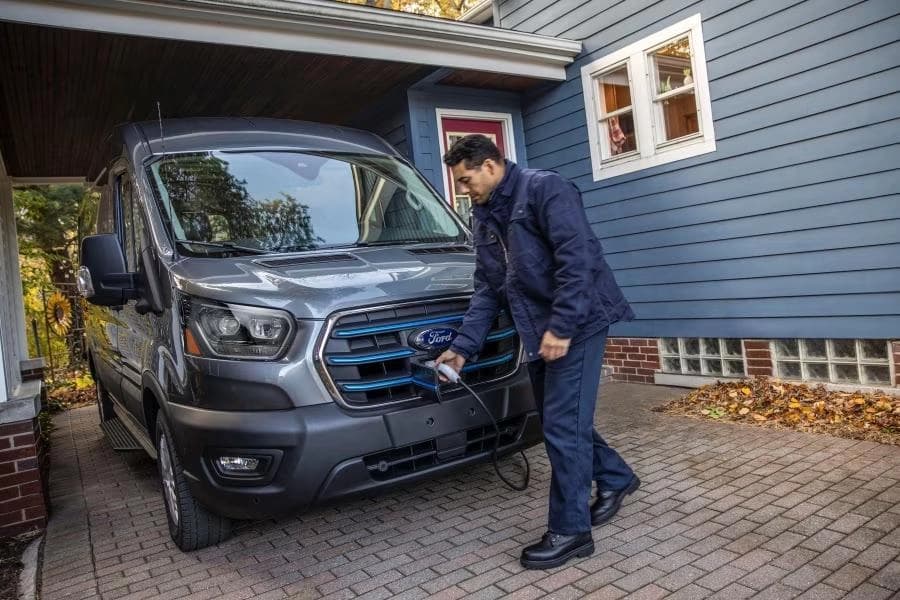
Image courtesy of Ford
Ford has once again found itself at the top of a leaderboard that no manufacturer actually wants to lead. On December 16, the Blue Oval officially triggered a recall for approximately 32,160 units of the 2022-2025 Ford E-Transit. For those who aren't familiar with the landscape of urban delivery, the E-Transit is essentially the silent, battery-powered backbone of the "last-mile" logistics world. It’s the van that brings you your midnight Amazon impulse buys without waking up the neighborhood. However, for about 32,000 owners, that silence might soon become a lot more permanent than they intended. The issue isn't a software glitch or a battery fire, which are the usual suspects in the EV era. Instead, it’s a classic, greasy, mechanical failure involving something called a half-shaft.
The technical details of the recall are a masterclass in why assembly line precision is the difference between a reliable tool and a very expensive driveway ornament. According to the National Highway Traffic Safety Administration (NHTSA), the left rear axle half-shaft on these vans may partially disengage from the primary drive unit. This happens because the "splines"—those little teeth that allow the shaft to lock into the drive unit and actually turn the wheels—weren't fully engaged during the assembly process. Ford’s internal investigation traced the root cause back to a manufacturing step where the force used to seat these shafts was, to put it politely, "insufficient." It’s the automotive equivalent of thinking you clicked your phone charger all the way in, only to wake up and find a dead battery. Except in this case, the "dead battery" is a 6,000-pound van losing all forward momentum while merging onto a busy interstate.
The human element of this story is what really lit up the owner forums and social media threads. Imagine you are a delivery driver navigating a steep hill in a drizzly city. Suddenly, the connection between your motor and your wheels effectively disappears. You have no drive power. You have no "Park" gear that actually holds the vehicle, because the mechanical link to the wheels is gone. If you don't have the presence of mind to immediately stomp on the electronic parking brake, your silent electric future becomes a very loud, rolling disaster. This "rollaway" risk is the primary reason the NHTSA is treating this with such urgency. It isn’t just about the van stopping; it’s about where the van goes once it has stopped.
What makes this particularly frustrating for the fleet managers and small business owners who rely on these vehicles is the current status of the "fix." As of right now, there isn't one. Ford has stated that the remedy is still under development. Interim notification letters are being mailed out today, December 22, to let owners know their vans might be haunted by a ghost in the drivetrain, but the actual mechanical solution isn't expected until March 2026. This leaves thousands of operators in a precarious position. Do you keep running the van and hope your half-shaft splines aren't the ones that were "insufficiently" shoved into place? Ford’s current advice is to always, without exception, use the electronic parking brake. It’s sound advice, but it’s a bit like being told your parachute might have a hole in it, but "don't worry, just try to land in some bushes."
From an industry perspective, this recall highlights a recurring theme in Ford’s recent history. Despite massive investments in quality control and "Quality is Job 1" marketing pushes, the company continues to struggle with these fundamental manufacturing hurdles. The E-Transit is a fantastic piece of engineering—it’s quick, efficient, and surprisingly fun to drive for a bread box on wheels—but all that high-tech wizardry is rendered moot if a basic metal shaft isn't clicked in properly. For the enthusiasts and industry watchers at OptiCar, it’s a reminder that the transition to EVs doesn't mean we can stop worrying about the greasy bits. If anything, the instant torque of an electric motor puts even more stress on these components. If a spline isn't seated perfectly, that 300 lb-ft of instant twist is going to find the weak point and exploit it with ruthless efficiency.
Ultimately, this story resonates because it taps into a very primal fear for anyone who spends their day behind the wheel: the sudden, total loss of control. Whether you’re a contractor with a single van or a fleet boss with five hundred, the idea of a vehicle simply "unplugging" itself from its own power source is a nightmare scenario. As we wait for the March 2026 fix, the E-Transit community is left to double-check their parking brakes and keep a very close ear out for any unusual clunking sounds from the rear axle. It’s a bumpy road for Ford’s electrification plans, and until those splines are sorted, the E-Transit remains a brilliant machine with one very annoying, very loose Achilles' heel.