CES 2026’s Breakout Star: The Robot That Plugs You In
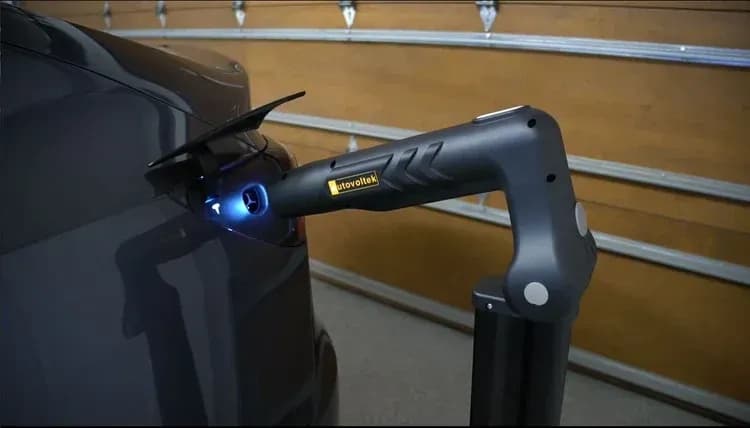
Image courtesy of Autovoltek
There is a specific category of technology at CES that I like to call "Solutions to Problems You Didn't Know You Had." This year, the undisputed king of that category is a company called Autovoltek, which has decided that the act of plugging a cable into a car is simply too much physical labor for the modern human to endure.
Enter the "ChargeRobot," a literal robot arm on wheels that lives in your garage. For the low, low price of $1,888 (plus installation, naturally), this little droid uses AI computer vision to hunt for your EV’s charge port, open the flap, and insert the connector. It’s essentially a roomba that wants to charge your Tesla.
I want to mock this. I really do. The enthusiast in me looks at this and screams, "It takes four seconds to plug in a car! Are we this slothful?" It feels like the Juiceicero of automotive tech—an over-engineered, expensive way to squeeze a bag of juice.
But then I watched the demo, and I felt a disturbing shift in my perspective.
Here is the pitch: You come home from work, tired, maybe carrying groceries or wrangling a screaming toddler. You park in your garage, walk inside, and forget about the car. The robot wakes up, scurries over, aligns itself using some genuinely impressive tracking software, and plugs you in. No more waking up at 6:00 AM with a panic attack because you realized you forgot to charge and now have 12% battery for a 40-mile commute.
For the average enthusiast, this is silly. We like cars. We look after them. But for the "normie" consumer—the person who treats a car like a toaster—this removes one of the biggest friction points of EV ownership. The "I forgot to plug it in" scenario is real, and it happens to the best of us.
The tech itself is surprisingly robust. It’s currently compatible mostly with Teslas (because the charge port location and opening mechanism are standardized and predictable), but Autovoltek claims they are working on adapters for other NACS and CCS vehicles. It doesn’t require precision parking; the robot has enough range of motion to find the port even if you parked like a jerk who was in a rush to find the bathroom.
Hyundai showed off something similar with their "Automatic Charging Robot" (ACR) concept, but that looked like a piece of industrial factory equipment bolted to the floor. The Autovoltek unit looks like a consumer electronics device—sleek, white plastic, non-threatening. It’s the difference between a robotic arm in a car factory and a PlayStation 6.
The $1,888 price tag is the biggest hurdle. You can buy a very nice standard Level 2 wall charger for $400. Is the luxury of not lifting your arm worth a $1,500 premium? For most people, absolutely not. But for the luxury buyer who already has a $100,000 Lucid or Plaid parked in a climate-controlled garage? This is pocket change for a cool party trick that also ensures they never run out of juice.
There is also an accessibility angle here that is genuinely important. for drivers with disabilities, mobility issues, or older folks for whom wrestling a thick, heavy copper cable is actually difficult, this isn’t a gadget—it’s independence. If Autovoltek leans into that angle, they might find a market that is far more grateful than the lazy tech bros they seem to be targeting.
Ultimately, this is classic CES. It’s weird, it’s expensive, and it solves a First World problem with excessive amounts of silicon and servos. But as we move toward a world where cars are increasingly autonomous, the idea that the car (or the garage) handles its own fueling is the logical next step. If your car can drive itself, why should you have to feed it?