Bentley’s Continental GT “Supersports” Brings Back the Driver’s Car
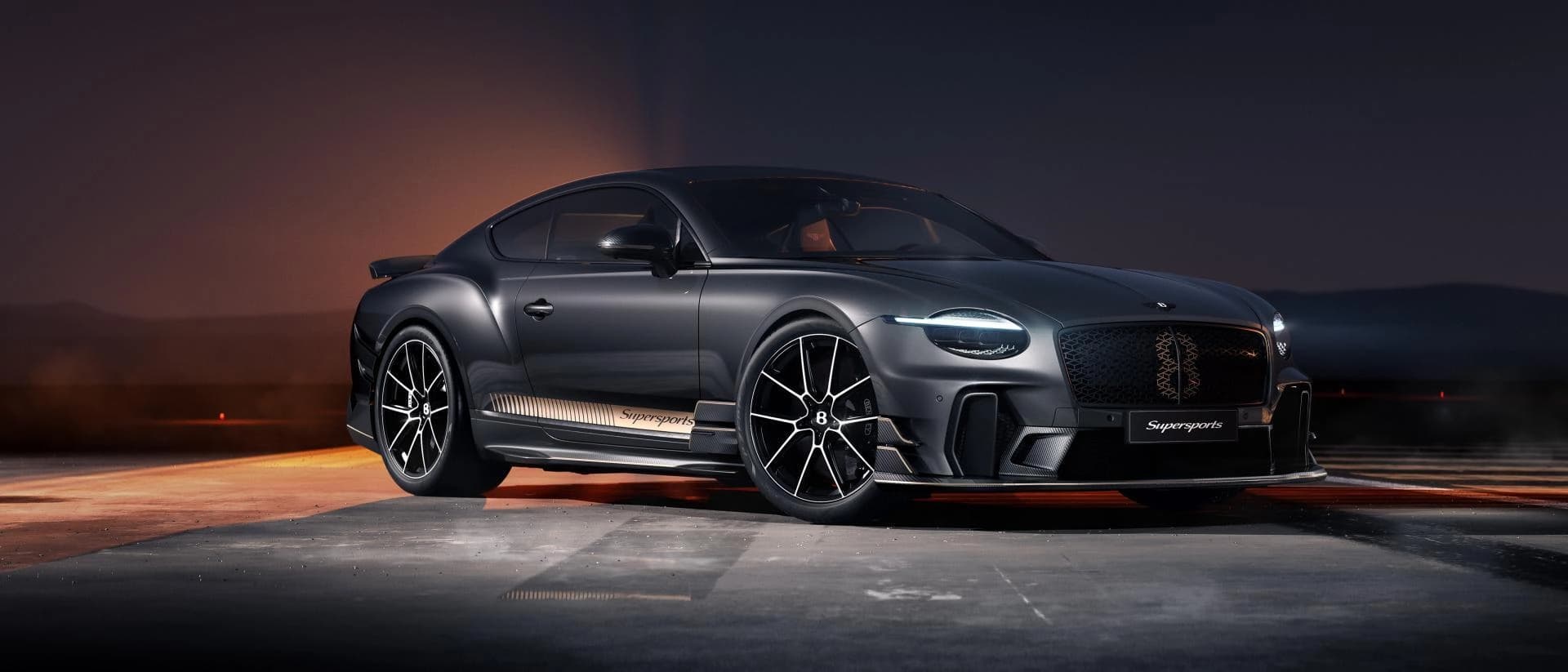
Bentley just unveiled the Continental GT Supersports, and it's the automotive equivalent of burning your ships before battle. This isn't your typical Continental GT with some extra badges and a bit more power. This is a fundamentally different machine, one that strips away the hybrid complexity and all-wheel-drive security blanket in favor of a purer, more unhinged experience. It's rear-wheel drive, it's nearly 1,000 pounds lighter than the standard car, and it only seats two people. Bentley looked at the electrified future, shrugged, and decided to build one last proper driver's car before the lights went out on internal combustion.
The numbers tell part of the story. The 4.0-liter twin-turbo V8 makes 657 horsepower (or 666 PS if you're into the metric drama), sent exclusively to the rear wheels through an eight-speed dual-clutch transmission. That's actually less power than the hybrid Continental GT Speed's 771 horses, but here's the thing: the Supersports weighs under 4,400 pounds, which for a Bentley is practically anorexic. The standard car tips the scales around 5,300 pounds. That missing half-ton makes all the difference.
Bentley achieved this weight loss through aggressive surgery. Out went the entire hybrid system, including the battery pack and electric motor. Gone are the rear seats, replaced with a carbon fiber structural shell. The roof is now carbon fiber too. The front splitter is massive, the rear wing is fixed, and there are dive planes, side sills, and a rear diffuser all made from carbon fiber. This isn't subtle. Bentley generated over 300 kilograms more downforce than a Continental GT Speed, and they want you to know it by looking.
What's remarkable is the commitment to rear-wheel drive. Every Continental GT since the nameplate's 2003 revival has been all-wheel drive, because when you're making 600-plus horsepower and weighing over two tons, sanity suggests putting power to all four corners. Bentley's chassis engineers apparently disagreed, arguing that freeing up the front wheels allows for more playful dynamics. They retuned everything: the dampers, the stability control, the electronic limited-slip differential, even the brake-based torque vectoring. The drive modes are specific to the Supersports, with even the gentlest "Touring" setting matching the Sport mode of a regular Continental GT Speed.
The performance numbers are properly absurd. Zero to 62 mph in 3.7 seconds, which is half a second slower than the heavier but more powerful GT Speed. Top speed around 192 mph. Lateral acceleration up to 1.3 g, which Bentley helpfully notes is comparable to a Koenigsegg CCX. These aren't the numbers you typically associate with a two-ton luxury grand tourer, even one that's shed considerable weight. The Supersports corners 30 percent quicker than a standard Continental GT, which suggests Bentley's engineers were serious about making this thing handle.
Inside, Bentley kept the luxury but added focus. The front seats sit lower and offer more support. The rotating display remains, but the overall vibe skews more toward driving than lounging. It's still a Bentley, so there's leather and Dinamica and carbon fiber everywhere, but the message is clear: this car is about the experience of driving, not being driven.
The exhaust system deserves special mention. Bentley worked with Akrapovič to create a full titanium system that's "significantly more characterful" than any previous Bentley. It's tuned to amplify the cross-plane V8's natural character without artificial enhancement. Given that most modern performance cars pipe fake exhaust noise through the speakers, this commitment to authenticity is refreshing. The Supersports will actually sound like a proper sports car, not a synthesizer trying to imitate one.
Only 500 will be built, each individually numbered with the number displayed on a dashboard plaque. Buyers can pick their own number, which is a nice touch for a car that starts over $486,000. Orders open in March 2026, with first deliveries in early 2027. By then, Bentley will be deep into their electrification strategy, making the Supersports a genuine swan song for the internal combustion Continental.
This is the first project completed under CEO Frank-Steffen Walliser, who came over from Porsche and clearly brought that company's enthusiast focus with him. His quote about the Supersports being "more than just the most driver-focused Bentley yet" and representing "a return to Bentley making more extreme cars" suggests this might not be a one-off. Bentley has historically thrived when they embrace their daring side, and the Supersports is certainly daring.
The bigger question is whether this matters. Bentley will sell all 500 without breaking a sweat. The people who buy these cars aren't worried about depreciation or practicality. They're buying the last of a breed, a rear-drive, non-hybrid, two-seat Bentley that prioritizes driving engagement over efficiency. It's a statement car, one that says Bentley remembers how to build something thrilling even as the rest of the industry goes electric. Sometimes the best way to face the future is to take one last victory lap in the present.